Part of an honest, long-shot attempt at the Navier–Stokes blow-up problem. This post is a sequel: last time we mapped a proven singularity as we turned on advection, and admitted one number was suspect. Here we pin it down, and are just as careful about what "pinned down" is worth. Still not a breakthrough. Still a toy model.
One scope note, added later (leg 180). Everything below is measured at positive
a. The published paper that proves a two-scale self-similar blowup scenario for this model family (Huang–Tong–Wang, arXiv:2603.25104) places that scenario ata ≤ 0, and reports one-scale blowups fora > 0, a statement about what degenerate initial data do. We are not continuing that scenario intoa > 0. We are continuing one specific object intoa > 0: the exact traveling-wave profile that sits ata = 0. That object exists at positiveain the published literature too (same paper, Theorem 2.7, for everyabelow 1). So when we say "the two-scale traveling wave survives to abouta ≈ 0.5", read it as: thisa > 0continuation of thea = 0wave keeps fitting to abouta ≈ 0.5. The number below is unchanged; only its label is.
The loose end
Last time we took a proven two-scale singularity of the
CLM model (a bump that both races toward the origin and narrows, its shape a fixed
"traveling wave") and asked what happens as you turn a knob a that adds
advection, sliding the model from CLM (a=0) toward the subtler De Gregorio
model (a=1). We let a genetic algorithm search for the best traveling-wave
profile at each a and measured how badly it fit. The answer: the wave doesn't
snap; it deforms smoothly, staying a good fit out to about a ≈ 0.4.
But we flagged one honest failure. That "0.4" was measured with a simple
family of profile shapes, and when we handed the search a richer family, the
fit at a = 0.5 improved four-fold: jumping back over the "good fit" line. So the
boundary we'd drawn was soft: maybe the wave genuinely dies around there, or
maybe our profiles were just too crude to keep up and a better tool would push the
boundary further out. We couldn't tell. This post is us telling.
The trap we had to avoid
The obvious move (keep enriching the profile family and watch where the boundary settles) hides a trap. A genetic algorithm reports the best fit it managed to find, and a richer family is a harder search. If we simply switched to fancier profiles, an improving fit could mean "the wave really does survive further out" or just "we threw more compute at a bigger haystack." Those look identical from the outside.
We caught this in the act. At a = 0.6, doubling the search budget improved the fit
by 45%: the number was tracking our effort, not the physics. Any conclusion
drawn at the old budget would have been noise.
So we did the boring, decisive thing first. We took a couple of points near the boundary and pushed the budget and the profile richness hard (up to ~8× the compute and a much larger family) and watched whether the fit kept improving or leveled off.
It leveled off. Past a certain budget the best fit stopped moving, and making the profile family richer stopped helping. That "leveling off" is the whole result: it means the number we're about to quote is a property of the equation, not of how hard we searched.
What the sharpened map says
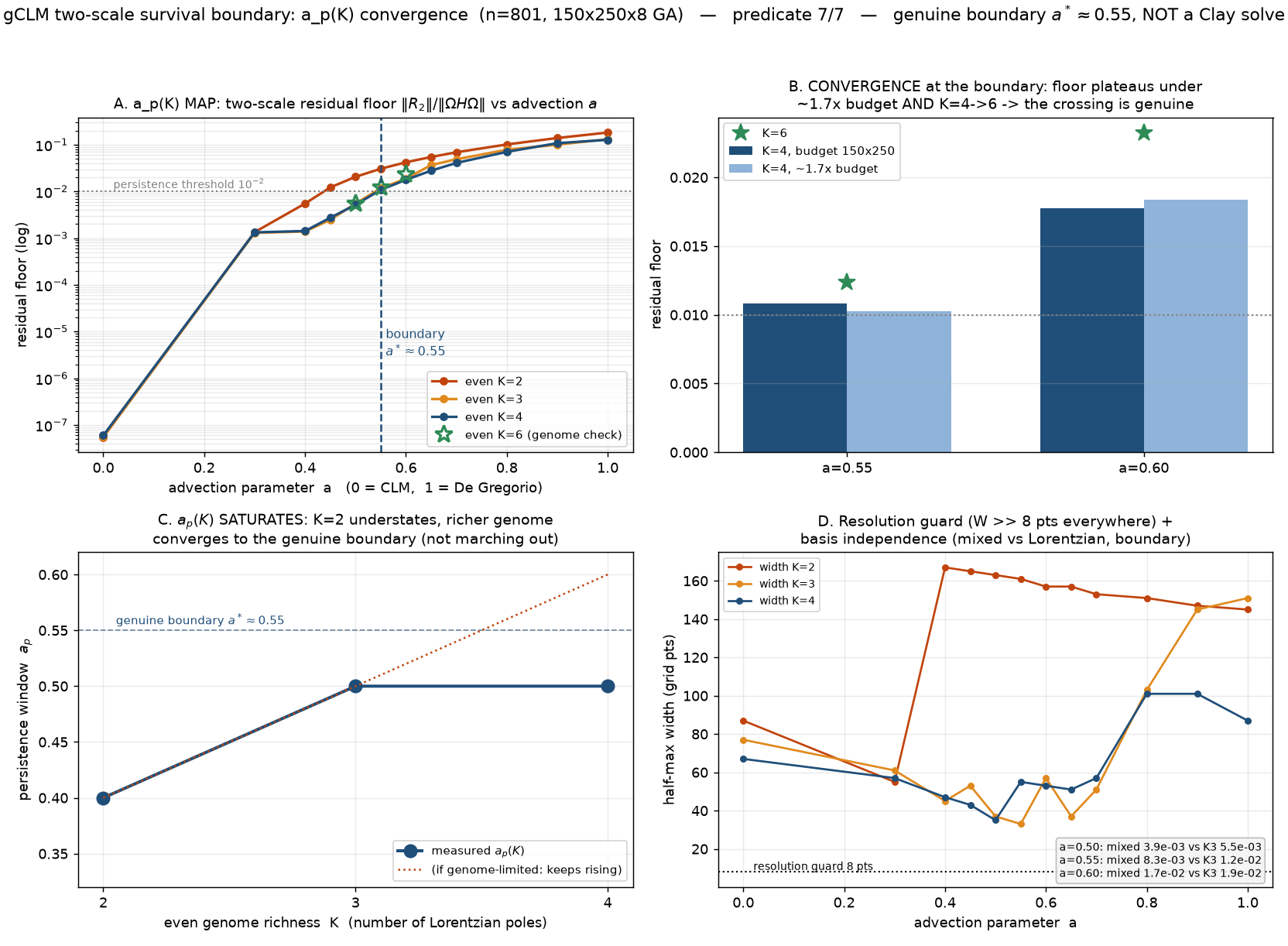
Now we can answer the loose end. We measured the survival boundary with families of increasing richness (call it K = 2, 3, 4 "pieces"), each at the converged budget:
- The simple family did understate it. Its boundary was
0.40; a richer family pushes it to0.50. - But it stops there. Going richer still (more pieces, and a completely
different kind of profile shape as a cross-check) does not push the boundary
any further. It saturates at about
a ≈ 0.5–0.55: a positivea, well inside the range we swept (a = 0up toa = 1).
That distinction is the point. If the boundary had kept sliding outward every time
we enriched the search, we'd have had to report defeat: "no real boundary here, our
tool just can't resolve it." Instead it converges. On positive a, the continuation of
the a = 0 two-scale traveling wave genuinely survives advection up to a ≈ 0.5, and
genuinely starts failing in the band 0.5–0.55, and beyond it degrades steadily to a
poor fit by the De Gregorio end, exactly as before. (What happens at a ≤ 0, the side the
published two-scale scenario lives on, we did not measure and do not claim.)
We ran three independent guards, and all three agree it's real: throwing more compute at the boundary doesn't move it, adding more profile pieces doesn't move it, and a structurally different profile family lands in the same place.
The thing we won't oversell
The boundary is a soft crossing, not a cliff. Right at a = 0.55 our different
profile families straddle the line: one just above the "good fit" threshold, one
just below. That's what the edge of a smoothly-worsening fit looks like; there's no
single magic a* where the wave vanishes. So the honest sentence is: "survives to
about 0.5, crosses the threshold around 0.5–0.55, and that crossing is real
rather than an artifact of a lazy search", not "dies at exactly 0.55."
What it's worth
Same ceiling as always, said plainly: a genetic algorithm minimizing a residual
proves nothing. This is sharpened evidence, not a theorem. What it genuinely
buys us is twofold: it closes out the honest caveat from last time (the boundary was
soft; now we know it's a genuine, converged feature near 0.5–0.55), and it hands
the next stage a much better-justified starting guess, the exact profile at
a=0, and the converged profiles right up to the boundary.
And that next stage is the one that actually matters. Everything so far lives on one rung of a ladder: a novel numerical map. The rung above it, the first that counts as genuine mathematics, is a rigorous, computer-assisted proof that one of these profiles corresponds to a real singularity, certified by interval arithmetic rather than a search. We haven't started it, and we're not going to pretend the sharpened map is anything more than a good guess to feed it. But it's the next thing we're building, and we'll be just as blunt about whether it works.